"If I Could Just…"
On independence, identity, and the long work of coming back to yourself

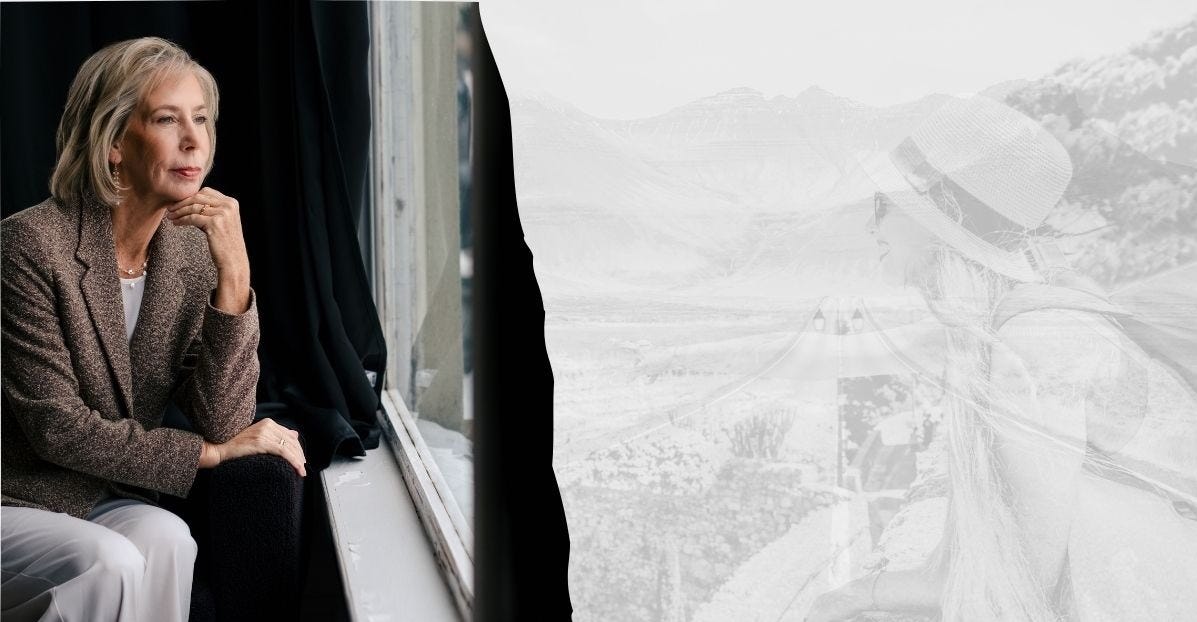
If I could just…
That was a phrase I repeated a lot during the caregiving years.
There were times I wanted to leave the house and start driving. No destination, no plan — just drive and see where I ended up. Not forever. Just a day, even half a day. On my own schedule, with no major preparation, no supplies to stock, no calculation of how far we’d get before Lee became too confused to continue and we’d have to turn back.
Always — with fierce and determined love — I stifled that wish and maintained the routine. Because with a dementia patient, the routine is everything.
Lee passed away earlier this year. And I can still feel the weight of those limits. They weren’t imposed on me, I took them on willingly, and I would take them on again without hesitation. But they were there. And their absence is something I am still learning to navigate.
When Lee and I met and later married, our partnership allowed us to compromise our independent lives in a way that never felt like loss. Joining our lives let us both grow — anchored by mutual love and support in a way that actually expanded rather than contracted who we each were.
And then the diagnosis came. And with it, the years of decline, caregiving, and a shrinking world.
There were times of real joy still — moments of connection, flashes of clarity and humor. But the needs grew. And with them came the slow erosion of independence, of self, of agency. For both of us.
The research on spousal caregiving documents this well. Financial resources are directed toward — and sometimes depleted by — the medical care of the ailing spouse. The caregiving spouse takes on a new and consuming identity as the manager of every household and family responsibility. Emotionally, the spousal caregiver attempts to maintain a delicate balance between enforcing treatment schedules and honoring their own needs within the relationship. Over time, as the demands increase, exhaustion — physical and emotional — becomes the baseline.
Independence returns after the passing of a loved one. But the transition is harder than it looks from the outside.
On one side of it: freedom. The ability to set your own schedule, pursue your own interests, eat what you want and sleep when you want — that last one, I cannot overstate. Old hobbies. New ones. Travel. Classes. The slow, necessary shedding of the emotional weight caregiving demands.
And most importantly: the chance to learn who you are again, outside the caregiver role.
On the other side: the disorientation that comes when the role disappears. The house too quiet. The social connections built around medical teams and support groups, fading. The complicated guilt of feeling relieved that the hardest work is over. The weight of making every choice alone.
I felt all of it. The freedom and the loss of it, arriving simultaneously.
It took time, work, and some trial and error to find not just things to fill the hours of each day, but things that filled my days with purpose. That distinction — between filling time and finding purpose — turned out to matter more than I expected.
For anyone navigating this space — newly solo, or somewhere in the long middle of it:
Independence, at this stage of life, is not the same thing as solitude. It is not the absence of need or the performance of not needing anyone. It is something quieter and more intentional than that.
It is the small acts. The trip you take because you decided to take it. The class you enrolled in because it interested you. The new hobby, the new friend, the morning you woke up and chose how the day would go without consulting anyone else’s needs first.
These tiny acts were how I found my way back. Not all at once. In glimpses — a familiar face in the mirror, a moment of recognition, the quiet sense that Vicki was still in there somewhere.
With each small act of independence, you are showing yourself something essential: that you are worth the trip. The class. The new skill. The new group of people who know this version of you rather than the one the caregiving years required.
You are building your identity again, from the ground up.
Heal first. Physically, emotionally, spiritually — in your own way, on your own schedule. There is no deadline. Grief and healing coexist. They always have.
Love your family and your friends — especially the ones who showed up when the caregiving days were hardest. They are the ones you hold close now.
And when you’re ready, look outward. You will always love your spouse. You’ll carry that love with you, tucked into a particular place in your heart that belongs only to them.
But there is a full life waiting to be lived. And it is yours to design.
Give yourself permission.
What was the first small act of independence that told you something was shifting? I’d love to hear in the comments.