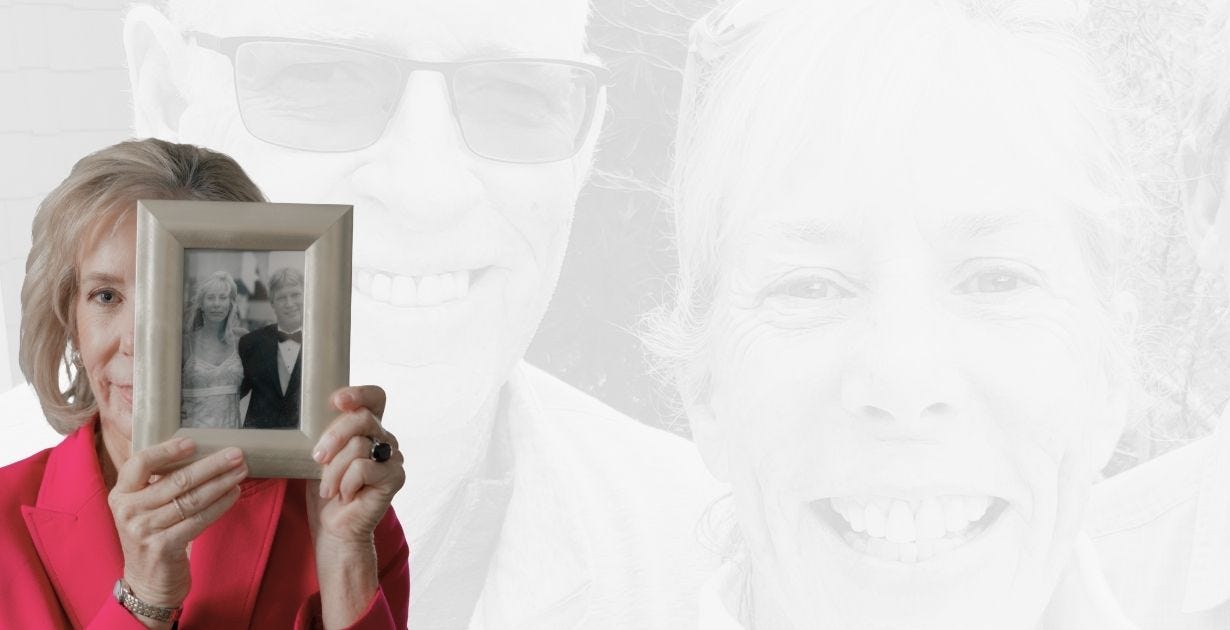
Widow Is a Word About Me. It Doesn't Describe Who I Am.
On missing your person — and learning, slowly, to come back to yourself.
Recently I went out to dinner with good friends. The ones who know everything.
It was raining — no, pouring. And without skipping a beat, D looked at his wife and me and said: I’ll be back with the car to pick you up.
That’s what I miss most days. Not the grand gestures. Not the anniversaries or the milestone moments. The ordinary ones. The person who noticed it was raining and went to get the car without being asked. The “day to day stuff.”
After you lose someone, everyone tells you: You were so lucky to have had them to love.
And it’s true. I was. But what they don’t quite understand is what it feels like to not have that person here to love you anymore. The loss isn’t only what you gave. It’s what you received.
On my recent trip to France, one of the women in our group was also a widow. We found ourselves talking, briefly, about life after husbands. The first sentence out of each of our mouths was the same.
I just miss my person.
My person. The person who I chose and who chose me back. The one who rubbed my back when I didn’t feel well, the one who listened to me go on about the idiot at the office, and the one who showed up each day, ready to live our life together.
That one.
I officially became a widow three and a half months ago.
I hadn’t been a wife in any real sense of the word for years — Alzheimer’s took that from us long before Lee died. But the finality of his physical passing was harder than I expected. And added to that grief was something I hadn’t anticipated: the word itself.
Widow.
At first I thought it would limit me somehow. That my options — to work, to play, to live — were restricted by this new status. I dreaded using it. If someone asked about my family, and since I don’t have children, I could say single — but that would erase everything. It would imply I hadn’t spent years loving someone, losing someone, holding on and letting go. Single felt like a lie of omission. Widow felt like a full stop.
I used the word a few times. I received sympathetic grunts. Looks. Kind of a careful silence that felt, however unintentionally, like being set aside. Like a pile of clothes waiting to be donated — still whole, still perfectly good, but no longer quite fitting into the room.
That is not what anyone intended. I know that. But it is what I heard. Widow felt like the end of the story. Like all the years of happiness and struggle and caregiving and grief had been compressed into five letters, and that was that.
Three and a half months down the road, I’ve planned and held the memorial service and the Celebration of Life — which I needed far more than I realized. Work continues. Projects continue. Even fun continues. I was, after all, just in Paris and Normandy. And the word “widow” feels a bit different now.
It’s hard work to not dwell on the past. There are days I ache to hear Lee go on endlessly about his golf game, or to hear him tell me it doesn’t matter what I’m wearing — that to him I am always the most beautiful woman in the room. Even when he was sick, he was my person, and his heart still beat. I took a strange, sustaining comfort from that.
When I was caregiving, I lost my identity. My sense of who I was anymore. I used small tactics to stay tethered — wearing a favorite shirt, getting fifteen minutes outside, finding the tiny moments that reminded me I still existed. Those small acts kept a thread of myself intact.
Now, on the other side, my identity after caregiving is still forming. It’s taking time. Because I am building it from scratch — not recovering a former self, but constructing something new, informed by everything I’ve lived through. And that’that’s okay.
I had wonderful years with my husband. I was lucky to have loved him. Now I’m back to learning to love myself — to belonging to myself again, in the way I wrote about when I started this newsletter, in the way I have been practicing, imperfectly and daily, ever since.
Widow is a word about me.
It doesn’t describe who I am.
What word or label have you struggled with — one that felt too small for the life it was supposed to contain? I’d love to hear in the comments.


Yes, I identify so much with all of this.